
Descripción
Most WordPress security plugins report a problem. They do not explain it. You get an alert that a file changed, a login failed, or a plugin is vulnerable. You do not get the reason, the risk, or the next step.
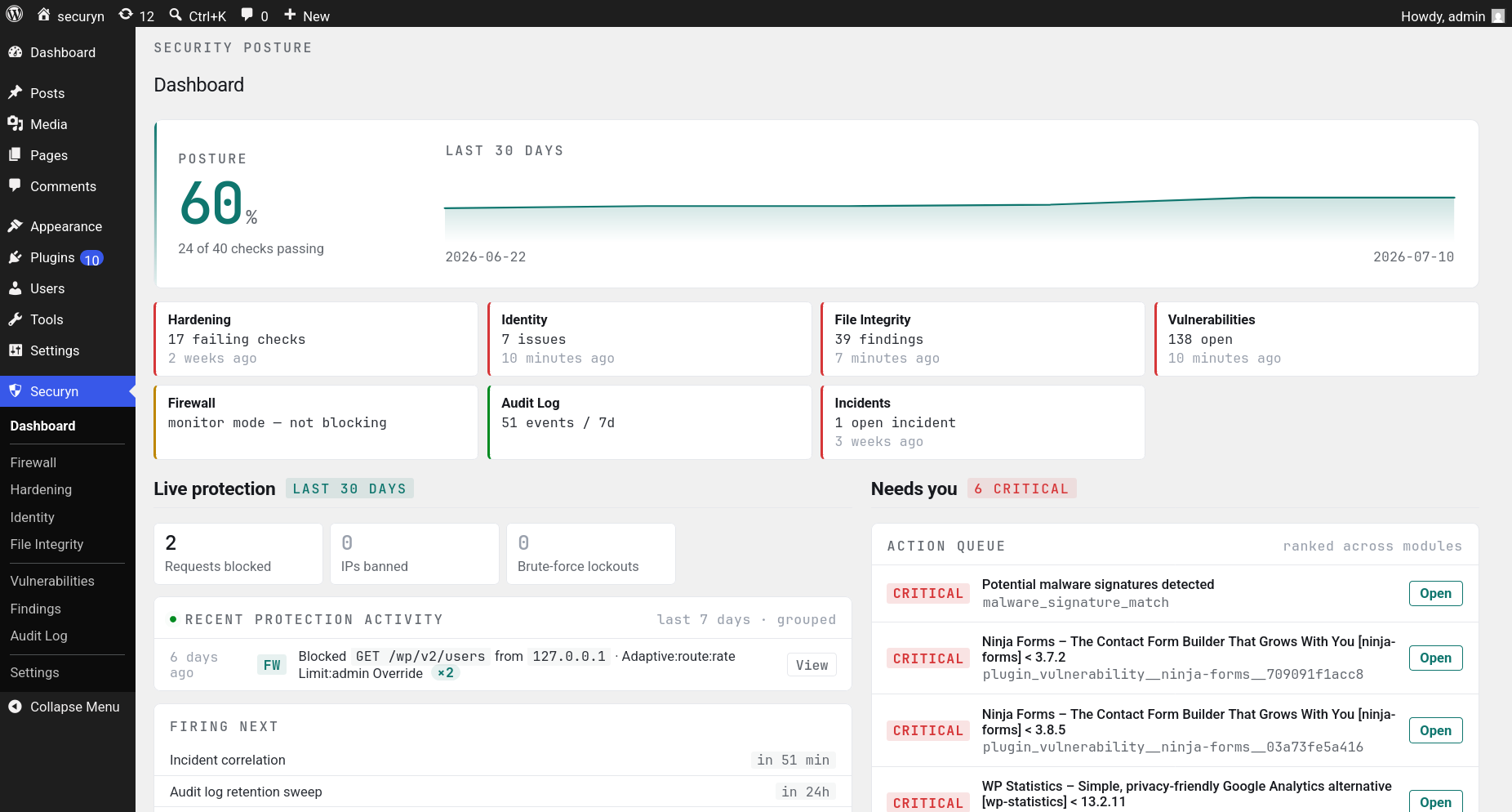
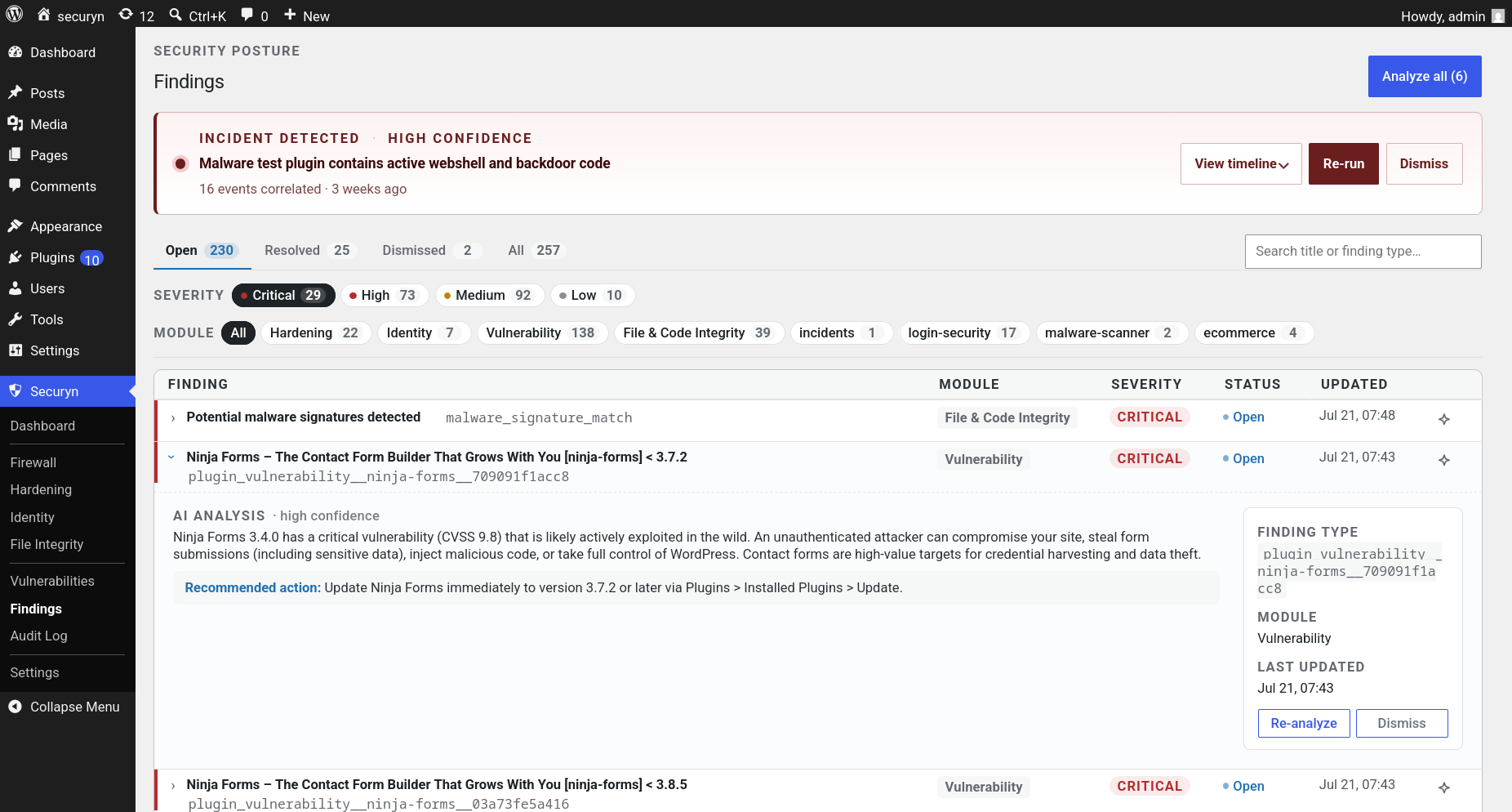
SecurynAI is different. SecurynAI watches your site, finds the security problems, and explains each one in plain language. For each finding, SecurynAI tells you three things: what happened, why it is a risk, and the WordPress screen to open to correct it.
SecurynAI is a detect-and-guide plugin. SecurynAI does not change your plugins, themes, core files, or configuration for you. You stay in control of every change. SecurynAI shows you the problem and the correct screen. You decide when to act.
Firewall and brute-force protection
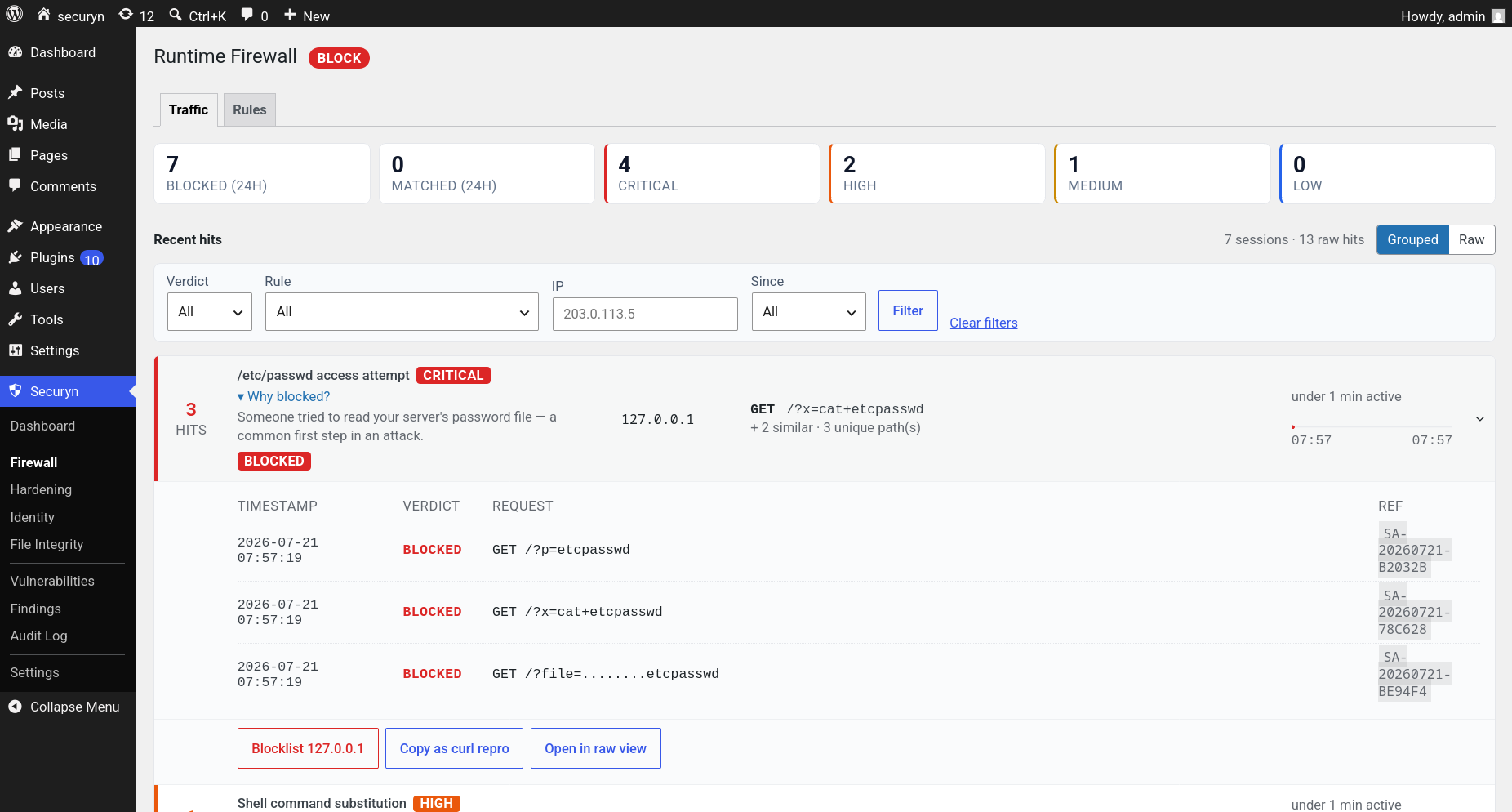
A request-time firewall blocks SQL injection, cross-site scripting, and remote code execution using an OWASP Top 5 ruleset. Repeat attackers trip a rate limiter and are added to an automatic blocklist, so credential-guessing and brute-force login attempts get shut down before they succeed — including attacks routed through xmlrpc.php, a common blind spot other firewalls miss.
Malware and file-integrity scanning
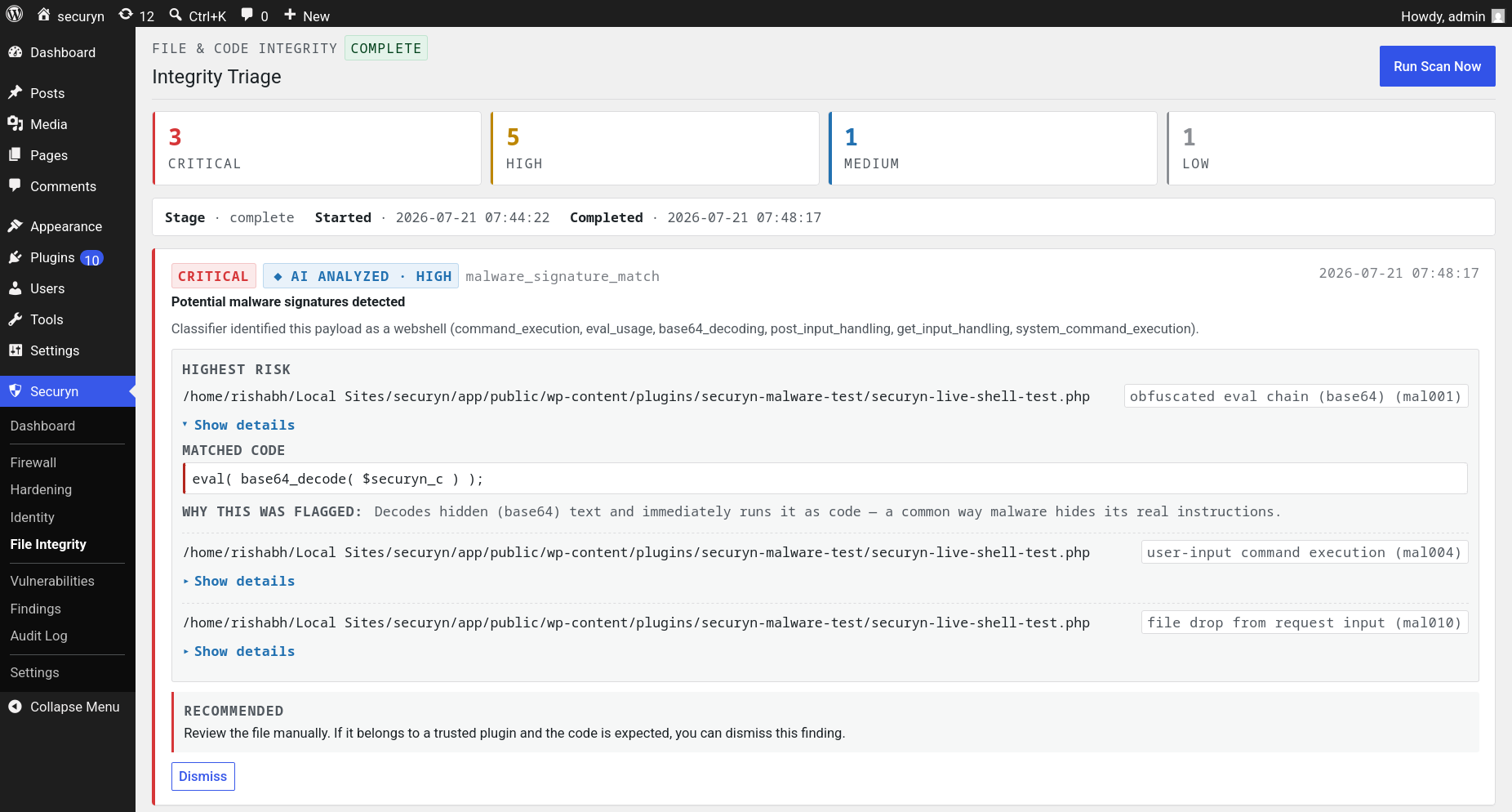
SecurynAI checks WordPress core, plugin, and theme files against official WordPress.org checksums, and scans for malware signatures and backdoors hiding in your file tree. A modified core file, an injected script, or a planted backdoor gets flagged with a plain-language explanation of what changed and why it matters — not just a raw file path.
Vulnerability scanner
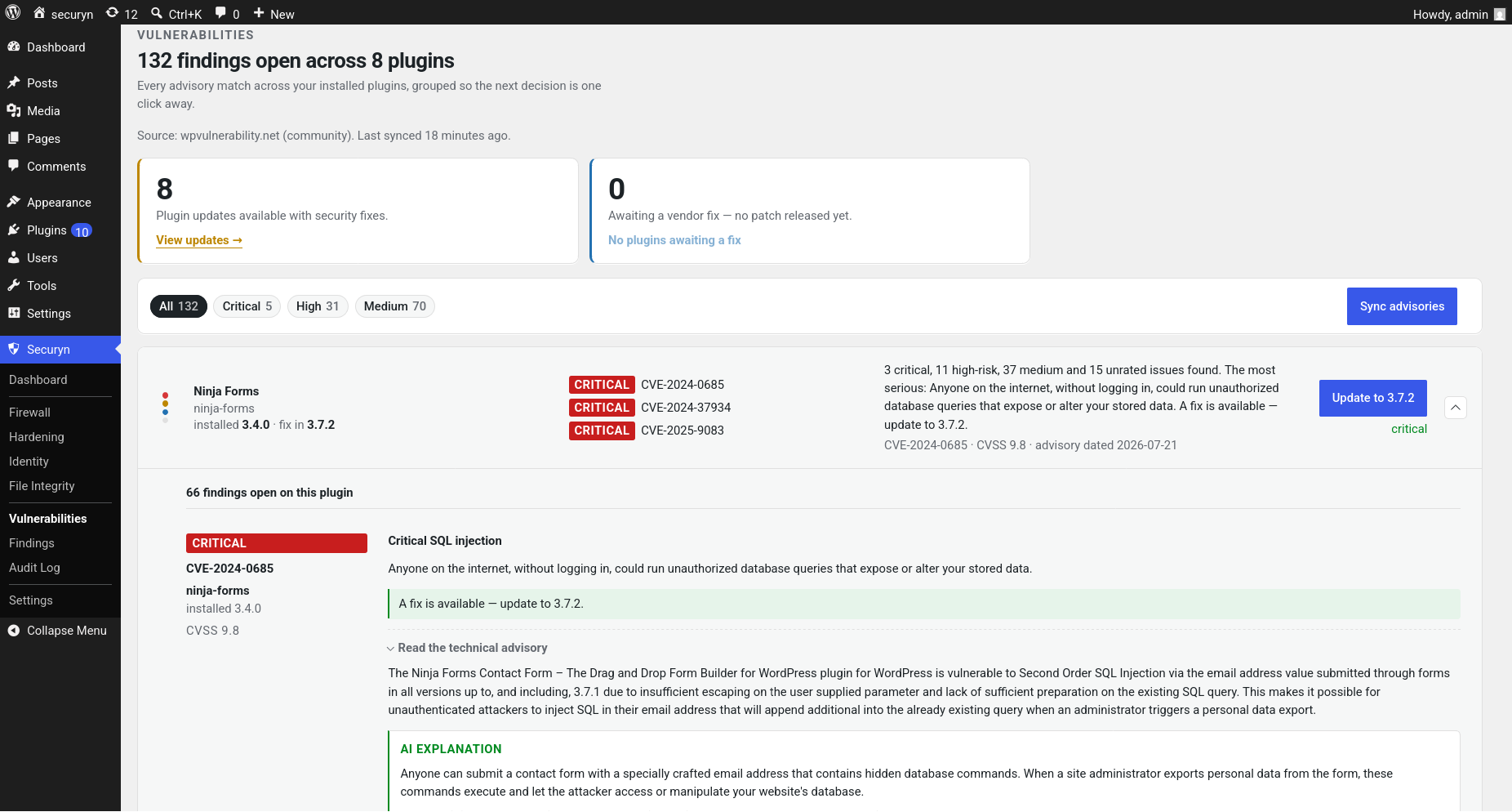
Every installed plugin and theme is checked against a known-vulnerability feed — wpvulnerability.net by default, or the Wordfence Intelligence v3 feed when you add a free Wordfence key — so you know which CVEs actually affect what you’re running, explained in plain English instead of a raw CVSS score.
Login security and identity checks
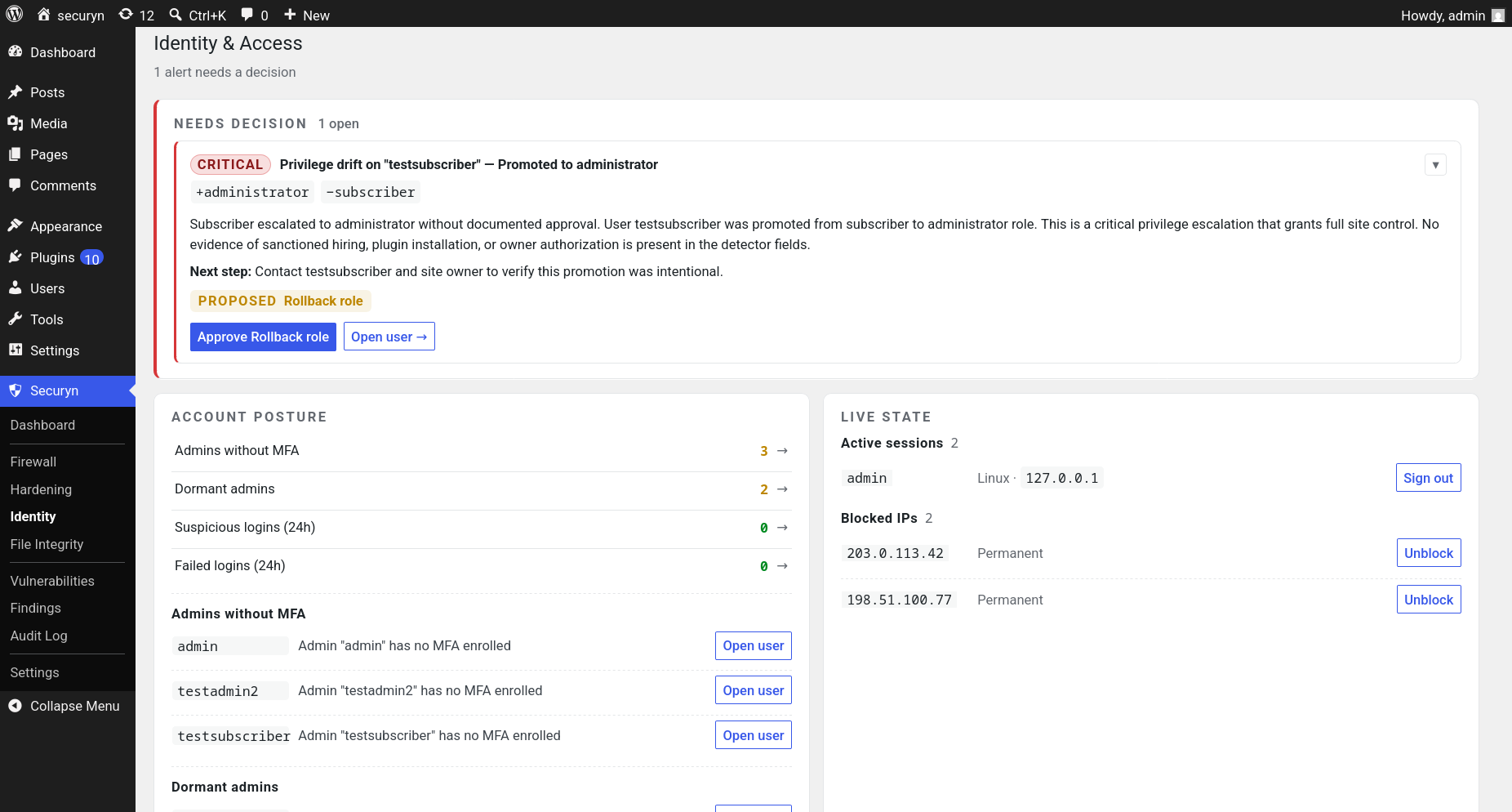
Login risk scoring flags unfamiliar device/IP combinations, off-hours access, and failed-login bursts. SecurynAI also checks whether your admin accounts have two-factor authentication enabled, flags dormant admin accounts that haven’t logged in for months, and watches for privilege drift — an account’s role or capabilities quietly changing.
Hardening and audit log
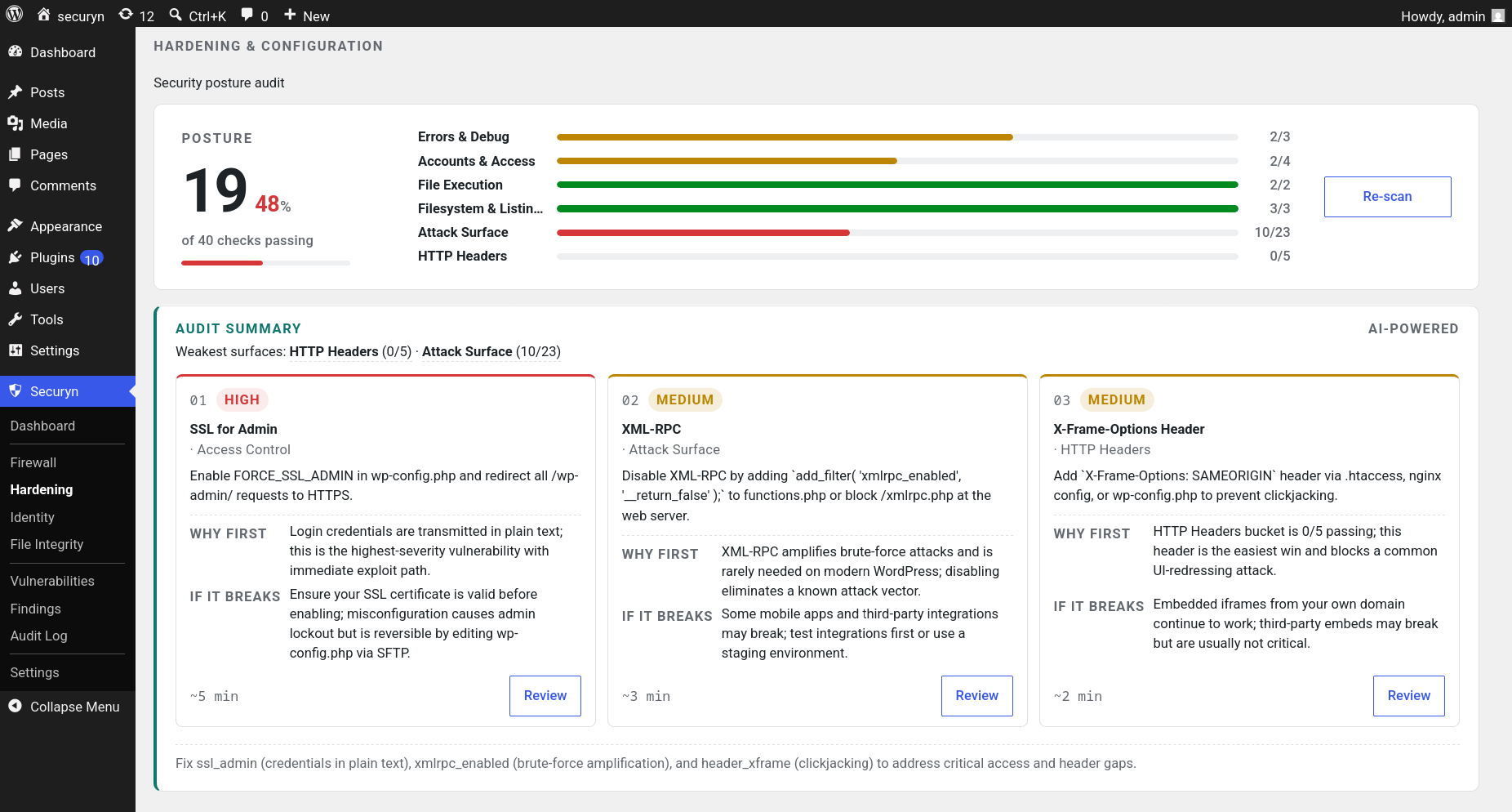
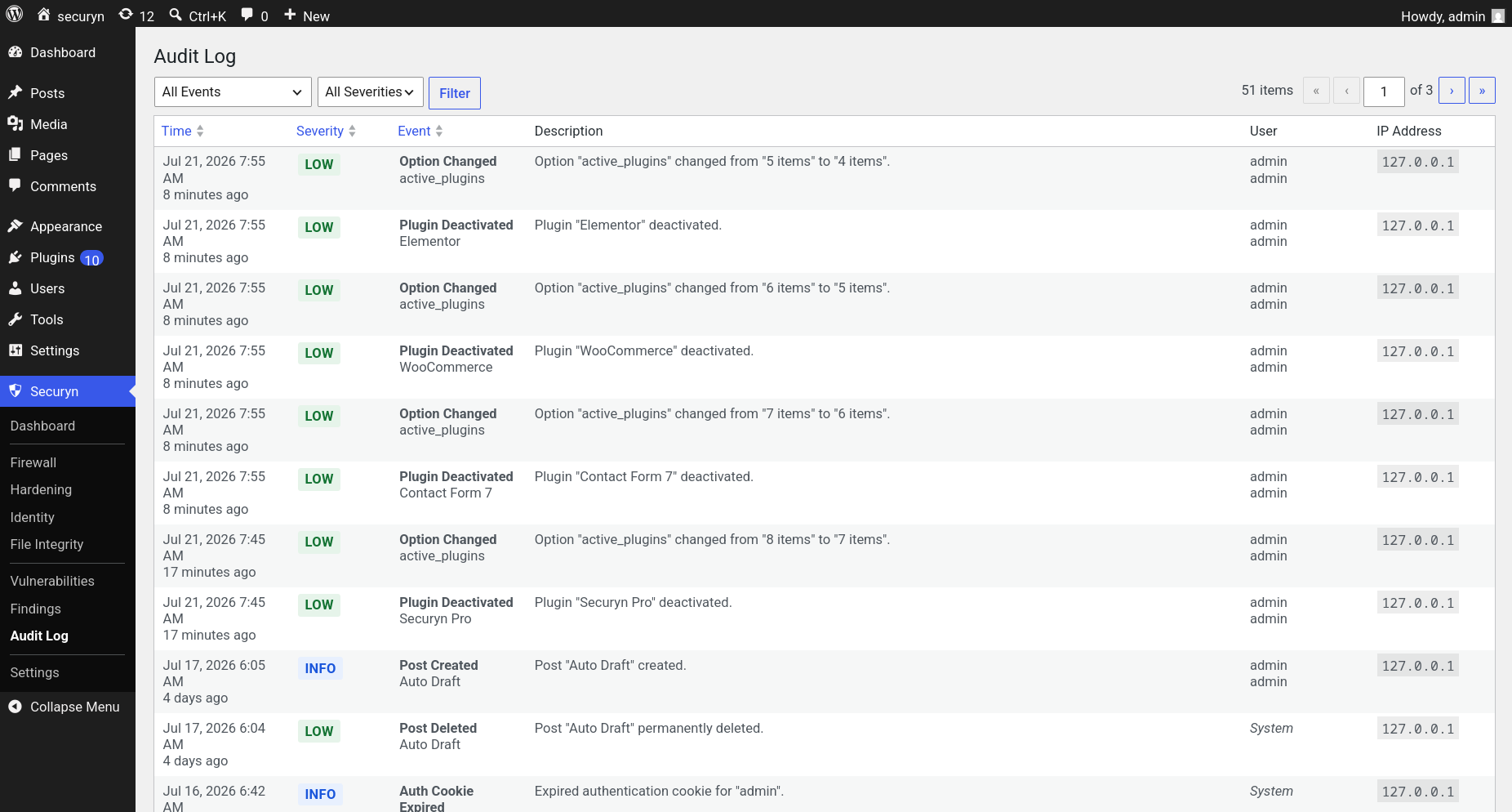
A hardening checklist walks through configuration gaps (wp-config, file permissions, admin usernames) with step-by-step guidance and an optional AI advisor. Every security-relevant event lands in a tamper-evident audit log with automatic retention cleanup, so you have a record when you need one.
Plain-language alerts
Each finding includes a short, human-readable explanation. You do not need to be a developer to understand what happened or what to do next. SecurynAI writes the alert in plain English and links you to the correct WordPress screen, such as Plugins or Updates.
AI features are optional
AI narratives use a Bring-Your-Own-Key model. You supply your own key from OpenAI, Anthropic, or Google Gemini. No request goes through a SecurynAI server. If you add no key, every non-AI tool continues to work — firewall, malware scanning, vulnerability alerts, login security, hardening checks, and the audit log all run with no key required. Only the AI narratives and the AI triage turn off.
Learn more, compare SecurynAI to other WordPress security plugins, and read plain-English guides to common alerts at https://securynai.com/.
Third-Party Services
This plugin connects to the following external services under specific conditions. No data is sent unless the described trigger occurs.
WordPress.org APIs
The file-integrity module fetches official checksums and package metadata from WordPress.org to verify that core files, plugins, and themes have not been tampered with. Only the component slug and version are transmitted; no site or user data is sent.
Data sent: WordPress version and locale (core checksums), plugin slug and version (plugin checksums), theme slug (theme info).
When: during a file-integrity scan, or when a component is checked against its official checksums.
The vulnerability module also queries api.wordpress.org/plugins/info/1.2/ (via the WordPress core plugins_api() function) to check whether each installed plugin slug is still listed in the official plugin directory. Only the plugin slug is transmitted.
Data sent: plugin slug.
When: on the scheduled vulnerability sync (every 4 days by default) and when manually triggered.
- Service: WordPress.org
- License: https://wordpress.org/about/license/
- Privacy Policy: https://wordpress.org/about/privacy/
Wordfence Intelligence v3
The vulnerability scanner fetches CVE data from the Wordfence Intelligence v3 feed to check installed plugins and themes against known vulnerabilities. Requests are made on a scheduled basis (daily by default) and cached locally. A free Wordfence API key is required; you can obtain one at wordfence.com.
Data sent: an HTTP GET request containing the plugin’s user-agent string and the Wordfence API key (as a Bearer token in the Authorization header). No site URLs, user data, or other site-specific information is transmitted.
When: on the scheduled vulnerability sync and when manually triggered from the SecurynAI dashboard.
- Service: Wordfence Intelligence
- Terms and Conditions: https://www.wordfence.com/wordfence-intelligence-terms-and-conditions/
- Privacy Policy: https://www.wordfence.com/privacy-policy/
WPVulnerability
The vulnerability scanner queries the wpvulnerability.net API for CVE data. This is the default vulnerability source when no Wordfence API key is configured, and serves as a fallback if the Wordfence feed is unreachable.
Data sent: plugin/theme slug or WordPress version in the URL path. No site-specific or user-specific data is transmitted.
When: during a scheduled or manual vulnerability sync, whenever wpvulnerability.net is the active source.
Note: the project runs its API on the wpvulnerability.net domain (the endpoint this plugin queries), while its website, documentation, Terms of Use, and Privacy Policy are hosted on wpvulnerability.com.
- Service: WPVulnerability
- Terms of Use: https://www.wpvulnerability.com/license/
- Privacy Policy: https://www.wpvulnerability.com/privacy
OpenAI API (optional)
If you configure an OpenAI API key under SecurynAI > Settings, the plugin sends security finding summaries to the OpenAI API for AI-assisted narratives and triage.
Data sent: security finding summaries (vulnerability descriptions, hardening check results). No credentials, user data, or site URLs are included in the payload.
When: only when an API key is configured and a user views a finding detail or triggers AI triage.
- Service: OpenAI
- Terms of Use: https://openai.com/policies/terms-of-use/
- Privacy Policy: https://openai.com/policies/privacy-policy/
Anthropic API (optional)
If you configure an Anthropic API key under SecurynAI > Settings, the plugin sends security finding summaries to the Anthropic API for AI-assisted narratives and triage.
Data sent: security finding summaries (vulnerability descriptions, hardening check results). No credentials, user data, or site URLs are included in the payload.
When: only when an API key is configured and a user views a finding detail or triggers AI triage.
- Service: Anthropic
- Terms of Service: https://www.anthropic.com/legal/commercial-terms
- Privacy Policy: https://www.anthropic.com/legal/privacy
Google Gemini API (optional)
If you configure a Google Gemini API key under SecurynAI > Settings, the plugin sends security finding summaries to the Google Generative Language API for AI-assisted narratives and triage.
Data sent: security finding summaries (vulnerability descriptions, hardening check results). No credentials, user data, or site URLs are included in the payload.
When: only when an API key is configured and a user views a finding detail or triggers AI triage.
- Service: Google Gemini
- Terms of Use: https://ai.google.dev/gemini-api/terms
- Privacy Policy: https://policies.google.com/privacy
WordPress Core AI Client (WordPress 7.0+, optional)
On WordPress 7.0 and later, SecurynAI can delegate AI requests to the built-in WordPress AI Client via the Connectors API. The external provider contacted depends on the connector the site administrator has configured in WordPress settings. SecurynAI sends the same security finding summaries described above; no additional data is transmitted.
When: only when WordPress 7.0+ is detected, the core AI Client connector is active, and no BYOK API key is configured for another provider.
- Service: Determined by the site’s WordPress Connectors configuration
- Terms of Use: Depend on the configured connector provider
- Privacy Policy: Depend on the configured connector provider
Capturas
Instalación
- Upload the
securynfolder to the/wp-content/plugins/directory. Or install the plugin from the Plugins screen. - Activate the plugin from the Plugins screen in WordPress.
- Open the SecurynAI menu in the admin sidebar. Run the initial setup.
- Optional: add your OpenAI, Anthropic, or Google Gemini API key under SecurynAI > Settings to turn on AI narratives.
Preguntas frecuentes
-
Does SecurynAI fix hacked files automatically?
-
No. SecurynAI does not change your files for you. SecurynAI shows you what changed and why it is a risk. Then SecurynAI links you to the correct WordPress screen, so you make the change yourself. You stay in control of every action.
-
What is the difference between SecurynAI and Wordfence?
-
Wordfence and similar plugins report a problem, but they do not always explain it. SecurynAI explains each finding in plain language. SecurynAI tells you what happened, why it is a risk, and the exact screen to open to correct it. SecurynAI also combines a firewall, a vulnerability scanner, identity checks, file-integrity checks, hardening checks, and an audit log in one dashboard. SecurynAI can also use the Wordfence Intelligence v3 feed for vulnerability data when you add a free Wordfence key.
-
Do I need a developer to clean up a WordPress security problem?
-
No. SecurynAI writes each alert in plain language. SecurynAI links you to the WordPress screen where you make the change, such as Plugins or Updates. You do not need to read technical logs or edit code to understand the problem.
-
Does SecurynAI need an API key?
-
No. All non-AI tools work without a key. The AI narratives and the AI triage turn on only when you add a key.
-
Where does the vulnerability data come from?
-
SecurynAI uses the wpvulnerability.net feed by default. If you add a free Wordfence API key, SecurynAI uses the Wordfence Intelligence v3 feed and keeps wpvulnerability.net as a fallback. SecurynAI caches the results on your site.
-
Can agencies use SecurynAI on many sites?
-
Yes. SecurynAI works on any single WordPress site. An agency can install SecurynAI on each site it manages. Each site keeps its own findings, firewall rules, and audit log.
-
Does SecurynAI modify my plugins, themes, or core files?
-
No. SecurynAI does not write to your plugins, themes, core files, or wp-config. When SecurynAI finds a problem, it links you to the correct WordPress screen — Plugins, Updates, or a settings page. You make the change and stay in control. Manual controls, such as ending a suspicious login session, act only when you start them.
Reseñas
No hay reseñas para este plugin.
Colaboradores y desarrolladores
Este software es de código abierto. Las siguientes personas han contribuido a este plugin.
Colaboradores
Traduce “SecurynAI – Security, Firewall, Malware Scan, and Vulnerability Alerts” a tu idioma.
¿Interesado en el desarrollo?
Revisa el código, echa un vistazo al repositorio SVN o suscríbete al registro de desarrollo por RSS.
Registro de cambios
1.1.1
- Fixed: corrected the minimum required WordPress version to 6.2.
- Updated: tested up to WordPress 7.1.
1.1.0
- Rebranded to SecurynAI. No functional changes — same features, settings, and data.
1.0.0
Initial release.
- Runtime firewall with an OWASP Top 5 ruleset, rate limits, and an automatic blocklist.
- Vulnerability scanner that checks installed plugins and themes against the wpvulnerability.net feed, with an optional Wordfence Intelligence v3 feed.
- Identity module with login risk checks, session monitors, and privilege-drift alerts.
- File-integrity baseline and drift detection, verified against official WordPress.org checksums.
- Hardening checks with step-by-step guidance and an optional AI advisor.
- Tamper-evident audit log with automatic retention cleanup.
- Plain-language explanations for every finding, each linked to the correct WordPress screen.
- Optional AI narratives with a Bring-Your-Own-Key model (OpenAI, Anthropic, or Google Gemini).